
Run, Forrest, Run :
When Following the Fitness Trend Becomes the Point
Needs More Than a Training Plan
A perspective on the commercialization of fitness, the rise of social running culture, and what sport science should and should not consider progress.
There is an obvious reason to welcome the current explosion of interest in physical activity.
People are running. People are training. People are joining communities. People are setting goals. People are, in many cases, moving more than they otherwise might. Given the scale of global physical inactivity, this should be regarded as a positive development. But sport science should not be satisfied with simply counting participants.
We should be asking a more difficult question:
Are contemporary fitness trends actually addressing physical inactivity at a population level, or are they primarily creating increasingly sophisticated ways for already-active people to exercise, compete, consume and identify themselves as “fit”?
That is not an attack on running clubs, HYROX, wearable technology or the people who participate in them. It is a question about outcomes. And perhaps it is time we asked it more openly.
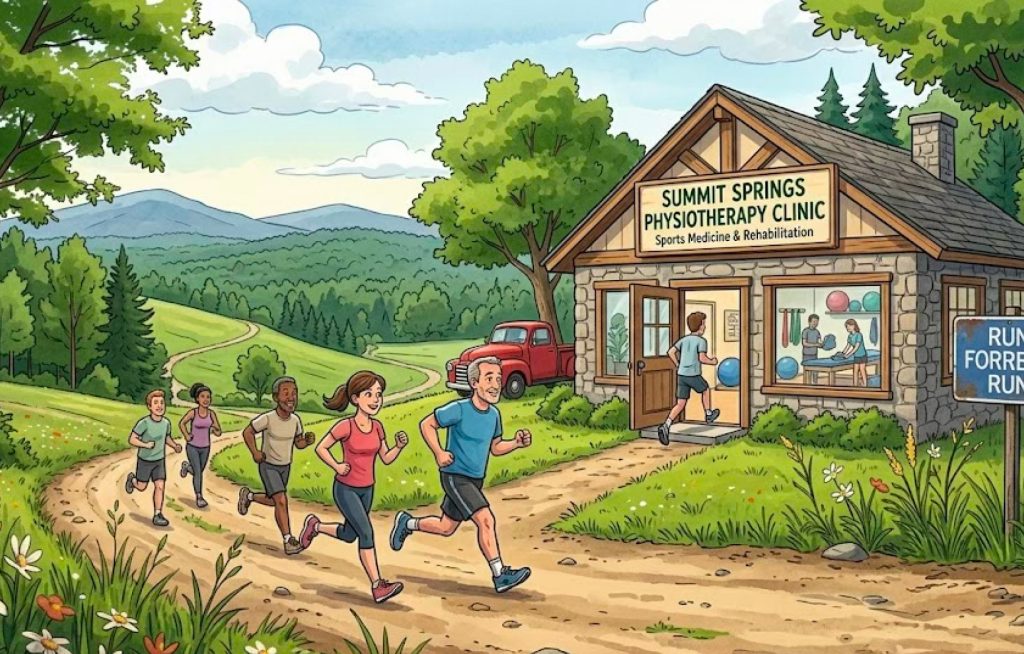
The title is deliberately ironic. Run, Forrest, Run is an instruction to keep moving. In today’s fitness culture, however, there is another interpretation: run because everyone else is running.
Follow the trend. Join the club. Buy the shoes. Track the kilometres. Post the run. Enter the race. Become the athlete. But somewhere beneath all of this activity, we should still ask whether the trend itself is taking us where we actually need to go.
We should be asking a more difficult question:
Are contemporary fitness trends actually addressing physical inactivity at a population level, or are they primarily creating increasingly sophisticated ways for already-active people to exercise, compete, consume and identify themselves as “fit”?
That is not an attack on running clubs, HYROX, wearable technology or the people who participate in them. It is a question about outcomes. And perhaps it is time we asked it more openly.
The title is deliberately ironic. Run, Forrest, Run is an instruction to keep moving. In today’s fitness culture, however, there is another interpretation: run because everyone else is running.
Follow the trend. Join the club. Buy the shoes. Track the kilometres. Post the run. Enter the race. Become the athlete. But somewhere beneath all of this activity, we should still ask whether the trend itself is taking us where we actually need to go.
The fitness boom is real. But what exactly is growing?
There has been substantial growth in social running, hybrid fitness competitions and technology-assisted exercise. Running, in particular, has evolved from an individual form of exercise into a highly social and increasingly commercial ecosystem. This development has considerable potential.
Community can improve exercise adherence. Social support can make physical activity more enjoyable. Goal-setting can provide motivation. Technology can provide useful feedback. Competition can encourage consistency. None of these benefits should be dismissed.
The problem arises when growth in a fitness product is implicitly treated as evidence of progress in public health.
Those are not equivalent outcomes. A running club can grow from 20 members to 2,000 members without necessarily reducing the number of people who are chronically inactive. A new fitness competition can sell thousands of entries without necessarily reaching the people at greatest risk from physical inactivity. A wearable company can sell millions of devices without knowing whether those devices have produced sustained changes in behavior. This is where a sport-science perspective becomes important.
We need to distinguish between the growth of fitness culture and the reduction of physical inactivity. They may overlap. But they are not synonymous.
The ‘Athlete’ identity: empowerment or consumer product?
One of the most interesting developments in contemporary fitness is the democratization of the term athlete. The word is no longer reserved exclusively for elite competitors. Recreational runners, gym-goers and participants in hybrid fitness events increasingly identify themselves as athletes. There is potentially something very positive about this.
Identity matters. If an individual begins to see physical activity as part of who they are rather than as an unpleasant obligation, that may support long-term adherence. Running can become a meaningful pursuit rather than simply another item on a list of health behaviors. But identity can also be commercialized.
Increasingly, the modern fitness identity appears to arrive with an accompanying consumption package: specialized footwear, technical apparel, wearable technology, recovery products, race entries and carefully curated social-media content. The athlete identity is no longer simply something you do. It can become something you buy. And that distinction deserves attention.
When equipment becomes part of the culture
There is nothing inherently wrong with expensive equipment. High-performance footwear has legitimate applications. Wearable technology can provide useful information. Technical clothing can be functional. Competitive athletes may reasonably invest heavily in equipment that supports performance. But the recreational participant is a different proposition.
The question is not whether a particular piece of equipment has a performance benefit. The question is whether that benefit is necessary for the person using it. A recreational runner does not need to dress like an elite athlete to obtain health benefits from running. Nor does a person need a premium GPS watch, carbon-plated shoes or specialist apparel to qualify as physically active. Yet contemporary fitness culture can sometimes make these distinctions difficult to see.
Social media is particularly powerful in this respect. What appears repeatedly in our feeds becomes normalized. If the dominant visual representation of running involves specialist shoes, expensive clothing, sophisticated watches, race medals and carefully documented performances, participation can begin to look like a consumer category rather than a health behavior. That matters because perceived barriers can become real barriers.
If someone believes that “proper” running requires expensive equipment, a particular physique or a certain level of performance, they may decide that running is simply not for them. That is precisely the opposite message from the one public health should be trying to communicate.
The visibility paradox
There is another issue that receives surprisingly little attention. The people most visible within contemporary fitness culture are not necessarily the people who most need physical activity.
The active population is highly visible. They post their runs. They upload their workouts. They record their race results. They share their equipment. They compare performances. The chronically inactive population is largely invisible. This creates a potential distortion in how we perceive the success of the fitness movement. Scroll through social media and it can appear as though everyone is running. Look at population-level physical-activity data and the picture is considerably less reassuring.
The World Health Organization has reported that approximately 31% of adults worldwide—around 1.8 billion people—were insufficiently physically active in 2022 and has projected that global inactivity could rise further if current trends continue. That juxtaposition should make the sport and exercise community pause.
How can fitness culture appear to be booming while physical inactivity remains such a substantial global problem? Perhaps the answer is that we are looking at two different populations.
Participation growth is not the same as public-health impact
This distinction deserves to become much more central to discussions about fitness. Suppose a new fitness modality attracts one million participants. That sounds extraordinary. But what if 900,000 of those people were already physically active? The modality may still be highly successful. It may improve fitness, enjoyment, social connection and adherence among those participants. But its contribution to reducing population-level inactivity would be very different from what the headline participation figure might suggest. This is not an argument against these activities. It is an argument for better outcome measures.
Sport science should be asking:
- Who is participating?
- Who is not participating?
- How active were participants before they joined?
- Do they remain active over time?
- Are previously inactive individuals being recruited?
- Are participation barriers being reduced?
- Are benefits distributed equitably?
- What happens when the novelty disappears?
These questions are considerably more informative than simply asking how many people turned up.
The "Fitness Commuter" problem
There is also the possibility that some of the growth in new fitness modalities represents a redistribution of already-active individuals rather than a large-scale transition from inactivity to activity.
The conventional gym-goer moves into hybrid training. The CrossFit participant moves into HYROX. The recreational runner joins a social running club. The cyclist adds strength training. These may all be excellent decisions. But they do not necessarily represent new physical activity at the population level. In other words, we may sometimes be moving active people between modalities rather than moving inactive people into activity.
Again, this does not make the trend bad. It simply means that we should be precise about what success actually means.
The socioeconomic question we cannot ignore
The commercialization of fitness also raises an issue that sport science cannot comfortably leave to marketers. Who can afford to participate?
Race fees, gym memberships, specialist footwear, wearable technology and technical apparel can collectively create substantial costs. For higher-income participants, these may be discretionary purchases associated with an enjoyable hobby. For others, they can constitute a meaningful barrier. This matters because the people most vulnerable to the consequences of physical inactivity are not necessarily the people with the greatest access to commercial fitness environments. If physical activity is presented primarily through the language of premium products and aspirational lifestyles, we risk creating an unintended message: Fitness is something you purchase.
It isn’t. Physical activity is much broader than the fitness industry. Walking counts. Cycling counts. Gardening counts. Dancing counts. Taking the stairs counts. Playing recreational sport counts. Moving throughout the day counts. You do not need to become an “athlete” to obtain the health benefits associated with being physically active.
And Then There Is the Load Problem
There is another dimension to this conversation that deserves considerably more nuance: injury. The argument should not be that running is inherently harmful. It isn’t. Nor should the existence of running-related injuries be used to discourage people from becoming active. The more scientifically defensible issue is training-load management.
An individual who moves from relatively little running to substantially greater running volume must accommodate a new mechanical demand. The cardiovascular system may feel capable of handling the workload before the musculoskeletal system has fully adapted to it. That distinction matters. A person can feel fit enough to complete a demanding session without necessarily being adequately conditioned to tolerate the cumulative loading involved.
Social exercise environments can make this particularly relevant. The group is running five kilometers. You have only been running two. You don’t want to be left behind. So you run five. Then you do it again next week. And again. The problem is not the social run. The problem is that social motivation can sometimes outpace biological adaptation. That is where the principles of progressive overload, appropriate recovery and individualized training become particularly important.
Fitness is not the same as readiness
This is a distinction worth making explicitly. Being generally fit does not automatically mean being prepared for every physical demand. A person can have reasonable cardiorespiratory fitness and still lack the specific musculoskeletal conditioning required for repeated running. A person can be strong in the gym and still be poorly conditioned for a high-volume running program. A person can feel psychologically ready to race without being physically prepared for the workload.
Training specificity matters. Progression matters. Recovery matters. And the body does not care whether the motivation came from a coach, a friend, an Instagram post, a Strava segment or a race-entry deadline. Tissues adapt to load, not motivation. That should remain one of the simplest principles underpinning any responsible fitness culture.
We Should Not Confuse Criticism With Condemnation
At this point, it would be easy to misinterpret the argument. This is not an anti-running article. It is not an anti-HYROX article. It is not an anti-run-club article. And it certainly is not an argument that people should stop enjoying the social and competitive dimensions of exercise. Quite the opposite. These environments can be exceptionally effective at creating something public-health interventions often struggle to create: engagement.
People participate because they enjoy it. They return because their friends are there. They train because they have a goal. They continue because they identify with the activity. Those are meaningful advantages. But we should not allow commercial success and cultural visibility to substitute for scientific evaluation.
Perhaps we need to make fitness less impressive
There is something almost radical about making physical activity boring again. No race. No performance target. No wearable. No premium shoe. No photograph. No leaderboard. Just a walk. Or a cycle. Or a swim. Or some resistance training in a public park. Or a game with your children. Or taking the stairs instead of the lift. These behaviors are not particularly glamorous. They do not necessarily generate engagement metrics. They are unlikely to produce much social-media content. But from a public-health perspective, their scalability may matter more than their glamour.
The challenge is not simply to create increasingly sophisticated ways for active people to become more engaged. The challenge is to create environments in which inactive people can begin moving—and continue moving.
What should we be building?
If the objective is genuinely to address physical inactivity and associated non-communicable disease risk, the solution cannot rest entirely on individual motivation. We need environments that make movement easier. Walkable communities. Safe pedestrian infrastructure. Accessible cycling routes. Public green spaces. Free or affordable recreational facilities. Accessible community programs. Opportunities for physical activity that do not require a membership, race entry or expensive equipment. This is where sport science needs to engage with public health, urban planning, health policy and community development. Because the person who is already enthusiastic enough to spend hundreds on equipment is not necessarily the hardest person to motivate.
The harder question is: How do we reach the person who has never considered themselves a runner, athlete or fitness enthusiast in the first place? That is where the real public health challenge lies.
The sport science responsibility
Perhaps the greatest danger is not that fitness trends exist. It is that we stop questioning them because they appear successful. Sport science should be willing to ask uncomfortable questions of popular trends just as readily as it asks them of established practices.
Does the intervention work? For whom? Compared with what? For how long? At what cost? With what risks? And does it reach the population that actually needs it?
These are not hostile questions. They are scientific questions. The fitness industry is entitled to sell aspirations, competition, technology and lifestyle. But sport science should remain interested in outcomes rather than aesthetics.
Run, Forrest, run
So, by all means, run. Join the club. Enter the race. Buy the shoes if you want them. Track your kilometers. Chase your personal best. Wear the watch. Post the photograph. Enjoy the community. There is nothing inherently wrong with any of it. But occasionally, stop long enough to ask:
Are you following the trend—or is the trend actually serving you?
And if you are a coach, organizer, sport scientist, clinician or allied-health professional, ask the bigger question:
Are we making society more physically active, or are we simply making fitness more visible?
Those are very different achievements. The irony of Run, Forrest, Run is that Forrest was not trying to become a lifestyle brand. He was simply running. Perhaps there is a lesson in that. Physical activity does not need to be premium. It does not need to be fashionable. It does not need to be competitive. It does not need to be photographed. And it does not require an expensive uniform or an “athlete” identity. Sometimes, the most scientifically defensible intervention is also the least marketable: Move more. Move regularly. Progress appropriately. Recover. And make movement something ordinary people can actually sustain.
Because if the fitness revolution only reaches the people who already belong to it, then perhaps we should stop congratulating ourselves for how far we have run—and start asking who we have left behind.