
Rethinking Periodization:
Why Modern Athletic Preparation
Needs More Than a Training Plan
Periodization has long been the backbone of athletic preparation – a way of structuring training into progressive cycles so that an athlete peaks at the right moment without burning out along the way. Most coaches think periodization is about manipulating training volume and intensity. Modern sport suggests that’s only part of the picture.
As sport science has matured, so has our understanding of what periodization needs to account for. The traditional model of simply manipulating volume and intensity over time is no longer enough. Today’s best programs treat periodization as something far more dynamic: an integrated system that coordinates physical, technical, tactical, psychological, and recovery factors simultaneously, guided by continuous athlete monitoring.
What periodization does
At its core, periodization is a strategic way of breaking a training program into structured, progressive blocks. It typically operates across three timescales:
- Macrocycles – the long-term plan, often spanning a season or an Olympic cycle
- Mesocycles – medium-term blocks focused on specific adaptations
- Microcycles – short-term, usually weekly, training structures
The purpose of this structure is straightforward: it allows different training qualities – strength, endurance, power, and more – to be developed systematically, without overwhelming the athlete’s capacity to adapt and recover.
The established models
Most periodization approaches sit somewhere on a spectrum between linear, undulating, and block structures. Each manipulates training variables (volume, intensity, frequency, exercise selection) differently over time.
Linear Periodization is the traditional approach: a predictable, sequential progression from high volume and low intensity toward low volume and high intensity as competition approaches. It works well for less experienced athletes, single-peak sports, and situations with a predictable competition calendar.
Undulating Periodization changes training variables far more frequently – sometimes day to day. A daily undulating model might look like strength work on Monday, hypertrophy on Wednesday, and power on Friday. This approach adds variation and reduces monotony but tends to pay off most for athletes who already have a solid training history behind them.
Block Periodization, popularized by Yuri Verkhoshansky and later refined by Vladimir Issurin, assigns each training block a specific goal rather than trying to develop everything at once. It generally unfolds in three stages:
- Accumulation – high volume, with a focus on general qualities, strength, and aerobic development
- Transmutation – a shift toward sport-specific qualities, maximal strength, speed, and power
- Realisation – a taper phase designed to bring the athlete to peak performance for competition
Beyond these three, a range of other models exist – ATR, conjugate, concurrent, reverse linear, tactical, and flexible/autoregulated periodization among them – each suited to different athlete populations and competitive demands.
In elite practice, few programs stick rigidly to one model. Most blend elements from several, and pure linear periodization has increasingly become the domain of novice athletes and sports built around a single major competition.
Why the traditional model falls short
The reasoning is simple. Viewing training purely as a manipulation of volume and intensity is too simplistic for the demands of modern sport. Performance doesn’t emerge from physical conditioning alone – it’s the product of physiological, psychological, technical, tactical, and contextual factors all interacting at once. If periodization only coordinates physical load, it’s managing a fraction of what determines performance.
Periodization as an integrated system
The practical implication is significant: instead of planning physical training loads in isolation, coaches should be periodizing multiple domains simultaneously. Training, in this view, becomes a coordinated process rather than a set of separate “fitness” and “skills” blocks running on parallel but disconnected tracks.
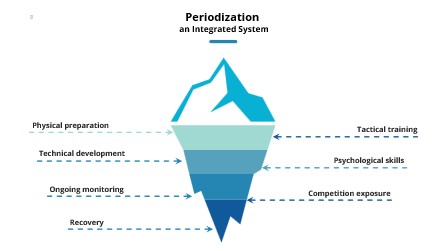
Monitoring should drive the plan
None of this works without data. Periodization decisions should be grounded in ongoing monitoring of external load, internal load, recovery status, and performance metrics. That’s a demanding standard to meet, but the growing accessibility and affordability of monitoring technology have made it far more achievable than it once was.
This also reframes periodization itself: rather than a fixed, rigid plan, it becomes a living process. Athletes adapt at different rates, injuries happen, travel adds fatigue, competition schedules shift, and illness intervene. A periodization model that can’t respond to that reality will always be working against the athlete rather than for them.
Managing the complexity, especially in team sport
This complexity is most visible in team sports, where individual athletes within the same program can have very different needs. Effective training isn’t just the sum of individual sessions – it’s an orchestrated process across multiple timescales.
- At the macrocycle level, coaches set the long-term vision, positioning athletes to peak when it matters most across a season or competitive cycle.
- Mesocycles provide focused windows for developing specific adaptations – hypertrophy, maximal strength, speed, or aerobic capacity.
- Microcycles translate those blocks into weekly structures that balance training stress, recovery, and competition demands.
- At the daily level, each session is a deliberate interaction between physiological stimulus, recovery, technical work, and tactical preparation.
Underpinning all of it is individualization. Athletes are not identical biological systems – they differ in training history, biological maturity, genetics, injury background, competitive role, and psychological state. The same program can produce very different outcomes across different athletes, which means a coach’s role isn’t just to prescribe training but to interpret how each individual respond and adjust accordingly.
Physical qualities don't develop in isolation
One of the more important shifts in thinking is recognizing that strength, power, endurance, speed, and skill interact dynamically, rather than developing independently. Improvements in maximal strength can enhance power output. Greater aerobic capacity can speed up recovery between high-intensity efforts. But these relationships can just as easily work against each other – excessive endurance training can blunt strength and power gains through the interference effect, and excessive fatigue can compromise technical execution while raising injury risk.
The skill in periodization lies in understanding these interactions: designing training that amplifies the adaptations that reinforce each other while minimizing the ones that conflict.
The bottom line
The future of periodization is not choosing the perfect model. It is making better decisions, more often, using the best available information.
Periodization is best understood today as a dynamic, integrated, athlete-centered process – not a fixed sequence of training phases. Rather than focusing primarily on volume and intensity, effective programs coordinate physical, technical, tactical, psychological, and recovery components together, continuously adapting based on athlete monitoring, competition demands, and individual response.
This multifactorial view matters most in modern sport, where performance is never the product of a single training variable, but the outcome of many biological and contextual factors interacting at once.
Here are a few pieces worth reading.
- Hartmann, H., et al., Short-term periodization models: effects on strength and speed-strength performance. Sports medicine, 2015. 45(10): p. 1373–1386.
- Lorenz, D. and S. Morrison, Current concepts in periodization of strength and conditioning for the sports physical therapist. International journal of sports physical therapy, 2015. 10(6): p. 734.
- Moesgaard, L., et al., Effects of periodization on strength and muscle hypertrophy in volume-equated resistance training programs: a systematic review and meta-analysis. Sports Medicine, 2022. 52(7): p. 1647–1666.
- Mujika, I., et al., An integrated, multifactorial approach to periodization for optimal performance in individual and team sports. International journal of sports physiology and performance, 2018. 13(5): p. 538–561.
- Yameen, K. and A. Khan, Periodisation strategies: A meta-analysis unravelling the impact on optimising athletic peak performance. Journal of the College of Physicians and Surgeons Pakistan, 2024. 34(6): p. 707–712.