
What Makes a Champion?
Rethinking Early Specialization in Youth Sport
Needs More Than a Training Plan
What makes a champion? Is it thousands of hours spent mastering one sport from an early age, or is there something to be gained from a wider sporting journey?
David Epstein’s Range offers an interesting proposition for sport: early multidisciplinary practice, rather than early specialization, may provide a stronger foundation for world-class performance later in life. While Epstein’s argument extends well beyond sport, it raises an important question for anyone involved in youth athlete development: Are we asking children to specialize before they are ready to know what—and who—they might become?
It is important to acknowledge that the desire for early specialization is often well intended. Parents and coaches understandably want to give young athletes every possible opportunity to succeed. Making a school first team, accessing educational opportunities through sport, representing a region or country, or simply discovering a pathway in which a child can excel can all be powerful motivations. Early success can feel like evidence that a particular pathway is working.
But there is an important distinction between early success and long-term development.
Children are not simply smaller versions of adult athletes. They are developing physically, biologically, cognitively, emotionally and socially—and they do so at very different rates. Being the standout athlete at eight, ten or twelve does not necessarily mean becoming the standout athlete at adulthood. In fact, early talent identification is inherently difficult because biological maturation can create substantial differences between children of the same chronological age.
This is one reason why the concept of specialization deserves closer examination.
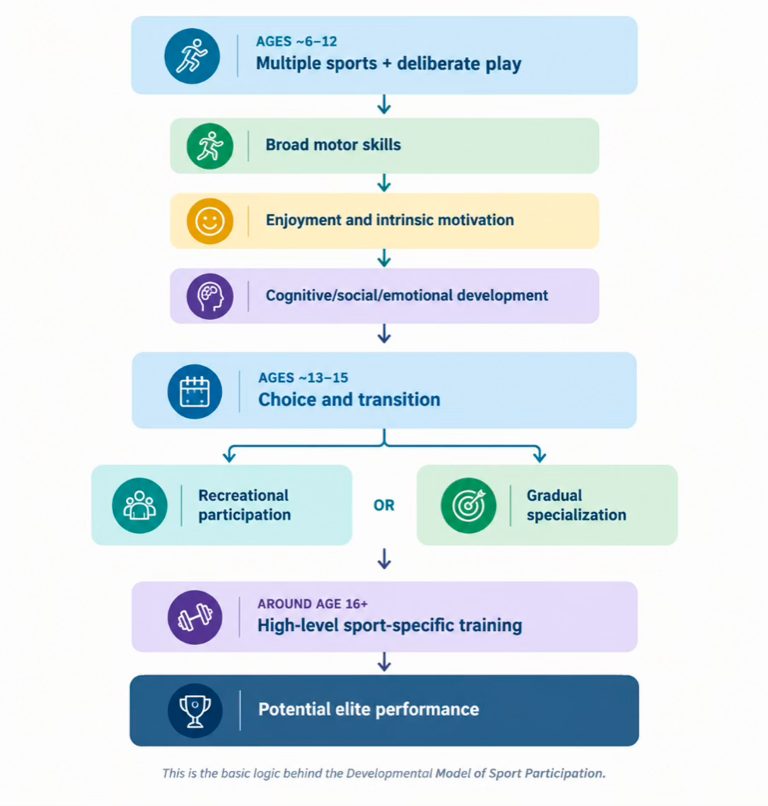
Specialization essentially means increasingly focusing on one sport, usually through greater sport-specific training and deliberate practice aimed at improving performance. Its counterpart is a more diversified sporting pathway, in which children experience multiple sports, engage in enjoyable and self-directed play, and develop a broad range of physical, cognitive, social and psychological skills before gradually narrowing their focus.
This distinction is important because specialization prioritizes depth, while diversification prioritizes breadth.
And breadth may have considerable value.
Across a range of sports elite athletes have often experienced multiple sports during childhood before increasing their commitment to their primary sport during adolescence. This does not mean that sampling multiple sports guarantees elite performance, nor does it mean that specialization is inherently harmful. Rather, it challenges the assumption that specializing as early as possible is a prerequisite for becoming an elite athlete.
There is also a developmental argument for allowing children to sample widely.
Different sports expose young athletes to different movement problems, environments, coaches, teammates and psychological challenges. A team sport may develop communication, cooperation and collective responsibility, while an individual sport may encourage independence, self-reliance and different forms of athlete–coach interaction. The child is not simply accumulating sporting experiences; they are developing as a person.
Youth sport, therefore, should not be viewed solely as a mechanism for producing better athletes. It is also an environment in which young people develop the social, psychological and interpersonal skills that they carry well beyond sport.
Perhaps even more importantly, different sports provide different opportunities to play.
Deliberate play—informal, enjoyable and often self-directed activity—allows children to experiment, adapt and solve problems without every action being prescribed by a coach. Through play, children encounter countless opportunities to develop coordination, agility, balance, perception, decision-making, creativity, problem-solving and adaptability.
What is learned in one sporting environment may later become an unexpected advantage in another.
A movement solution discovered while playing basketball might influence how a child moves onto a rugby pitch. The perceptual demands of badminton may contribute to skills useful elsewhere. The decision-making, adaptability and creativity developed through unstructured play may become valuable when the athlete eventually enters a more specialized environment.
Sampling, therefore, does not necessarily represent a detour from specialization. It may be part of the foundation upon which effective specialization is eventually built.
There is another element that is sometimes overlooked in the pursuit of performance: enjoyment.
Children generally engage in deliberate play because they want to. There is a degree of autonomy and ownership that can be lost when every sporting experience becomes structured around improvement, selection, competition and performance. Enjoyment can nurture intrinsic motivation, self-regulation and a lasting connection with sport.
That matters because the demands of elite sport become increasingly challenging with age.
An athlete who develops a genuine love of their sport during childhood may be better positioned to voluntarily embrace the demanding training that comes later. Enjoyment during childhood may therefore be more than a pleasant by-product of participation; it may help establish the motivational foundation for long-term commitment.
So, does this mean early specialization is always wrong?
No. And this is where the conversation becomes more nuanced.
There are important exceptions. Some sports have relatively early peak-performance ages or require highly specialized skills to be developed before full physical maturation. Gymnastics and figure skating are commonly cited examples. The history of athletes such as Tiger Woods also reminds us that exceptional performers can emerge from highly focused early engagement.
The more useful question, therefore, is not “Should every child specialize late?” but “When is specialization developmentally appropriate for this athlete, in this sport, and in this environment?”
For many sports, there is a strong rationale for allowing childhood to be a period of exploration, play and broad development, with sport-specific commitment increasing as the athlete matures. By later adolescence—around 16 in the framework discussed here—young athletes are generally better equipped to manage the physical, cognitive, emotional and social demands of increasingly specialized training.
This does not mean there is a magic birthday at which an athlete should suddenly specialize. Development does not work according to a calendar. The appropriate timing is individual, contextual and sport-dependent.
Perhaps this is the most important point for parents, coaches and sporting organizations.
The question should not simply be:
“Which sport should this child specialize in?”
Perhaps we should first ask:
“What does this child enjoy?
From there, the pathway can evolve. Children can experience different sports, develop broad movement competencies, discover what motivates them, and gradually invest more deeply in the sport that captures their interest and commitment.
Specialization does not need to be rejected. It needs to be timed thoughtfully.
For most sports and young athletes, allowing development to unfold before narrowing the pathway may offer important advantages—not only for performance, but for enjoyment, wellbeing and continued participation. The goal is not to delay specialization for the sake of delaying it. The goal is to ensure that when specialization arrives, the athlete is ready for it—and has developed the physical, psychological and motivational foundations to sustain it.
Because ultimately, the best young athlete is not necessarily the one who wins the race to specialize.
It may be the one who remains engaged, keeps developing, and is still there when it matters most.
Here are a few pieces worth reading
- Barth M, Güllich A, Macnamara BN, Hambrick DZ. Predictors of junior versus senior elite performance are opposite: a systematic review and meta-analysis of participation patterns. Sports Medicine. 2022;52(6):1399–416
- Côté J, Lidor R, Hackfort D. ISSP position stand: To sample or to specialize? Seven postulates about youth sport activities that lead to continued participation and elite performance. International journal of sport and exercise psychology. 2009;7(1):7–17
- Côté J, Vierimaa M. The developmental model of sport participation: 15 years after its first conceptualization. Science & sports. 2014;29:S63–S9
- Güllich A, Macnamara BN, Hambrick DZ. What makes a champion? Early multidisciplinary practice, not early specialization, predicts world-class performance. Perspectives on Psychological Science. 2022;17(1):6–29
- LaPrade RF, Agel J, Baker J, Brenner JS, Cordasco FA, Côté J, et al. AOSSM early sport specialization consensus statement. Orthopaedic journal of sports medicine. 2016;4(4):2325967116644241
- McLellan M, Allahabadi S, Pandya NK. Youth sports specialization and its effect on professional, elite, and olympic athlete performance, career longevity, and injury rates: a systematic review. Orthopaedic journal of sports medicine.2022;10(11):23259671221129594.